Berlin Neighbourhoods: Where to Base Yourself
A district-by-district guide to choosing where to stay in Berlin, from central Mitte to Kreuzberg, Prenzlauer Berg and Neukölln.
By Marta Oliveira · Published 20 January 2026 · Updated 25 February 2026 · 6 min read
At a glance
- Berlin is large and decentralised — pick a district, not just a hotel
- The U-Bahn and S-Bahn together make most neighbourhoods genuinely well connected
- Mitte is central but can feel corporate; outer districts have more local character
- Rent and hotel prices vary significantly by district and even by specific street
Berlin is considerably larger and more decentralised than Paris or Lisbon, and it has no single historic core where everything of interest sits within walking distance. Choosing a district to base yourself in matters more here than in a compact city, because a wrong guess can mean a 30-minute commute to the sights you actually came to see, rather than a short walk.
Mitte: central, historic, convenient — and sometimes impersonal
Mitte holds the Museum Island (a UNESCO World Heritage Site), the Brandenburg Gate, Unter den Linden and the government quarter, and staying here puts most of the classic sightseeing within walking distance. It is extremely well served by the U-Bahn and S-Bahn, with Friedrichstraße and Alexanderplatz both major interchange stations. The trade-off is that much of central Mitte, rebuilt heavily since reunification, can feel corporate and tourist-oriented after dark, with fewer of the independent bars and late-opening restaurants found further out.
Kreuzberg and Neukölln: nightlife, food and a younger crowd
Kreuzberg, split loosely between a quieter western half near the Landwehrkanal and a livelier eastern half around Schlesisches Tor, is known for its Turkish-German food culture, including the Saturday Türkenmarkt (Turkish Market) along the canal, and some of the city’s best-known nightlife, particularly around Görlitzer Park and Oranienstraße. Neukörn, just south-east, has absorbed much of the overflow of this scene in the past decade, especially around Weserstraße and Sonnenallee, and tends to be slightly cheaper while offering a similarly dense food and bar scene. Both districts are noisier on weekend nights, which matters if you are a light sleeper or travelling with young children.
- Mitte — central, museum-dense, well connected, can feel corporate after dark
- Kreuzberg — Turkish-German food culture, canal market, strong nightlife, noisier at weekends
- Neukölln — cheaper, similarly lively, good U8 line access, rapidly changing character
- Prenzlauer Berg — quiet, residential, family-friendly, good tram and U2 access
- Friedrichshain — street art, Boxhagener Platz market, nightlife near the East Side Gallery
Prenzlauer Berg: quiet, residential, family-friendly
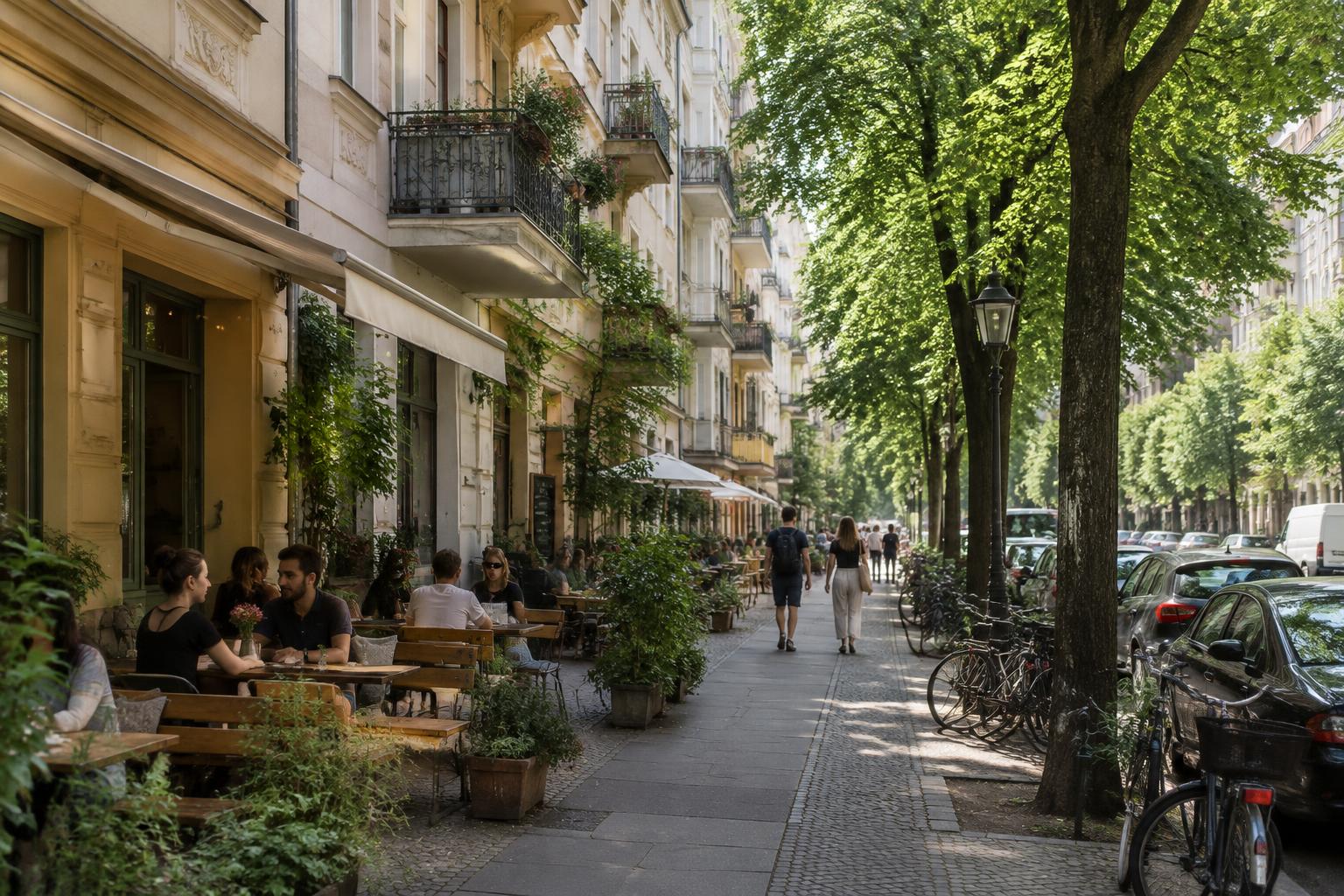
Prenzlauer Berg, in the former East Berlin, is now one of the city’s most gentrified and family-oriented districts, with wide pavements, restored 19th-century apartment blocks, playgrounds and a noticeably calmer pace in the evenings than Kreuzberg or Neukölln. It is served well by the U2 line and several tram routes, giving a reasonably fast connection into Mitte, and Kollwitzplatz hosts a popular Saturday farmers’ market. Travellers prioritising sleep and a slower pace over nightlife tend to do well here, though it sits further from the major museums than Mitte.
Friedrichshain: street art, markets and the East Side Gallery
Friedrichshain, adjoining Kreuzberg across the River Spree, holds the East Side Gallery — the longest remaining stretch of the Berlin Wall, now covered in murals — along with Boxhagener Platz, a lively square with a Saturday flea market and a cluster of cafés. The district has a strong nightlife scene of its own, centred loosely around Simon-Dach-Straße, and like Kreuzberg it is noisier at weekends than Prenzlauer Berg or outer Mitte.
Charlottenburg: the quieter, more traditional west
West Berlin’s former commercial heart, Charlottenburg, retains a more traditional, slightly formal character, built around the Kurfürstendamm shopping boulevard and Schloss Charlottenburg, Berlin’s largest surviving royal palace. It tends to suit travellers who prefer a calmer, more conventional hotel district with good shopping and reliable S-Bahn and U-Bahn links, over the more experimental scenes further east, though it sits further from Museum Island and the government quarter.
Matching a district to your actual plans
As with any city, the right base depends on what you intend to do. A trip built around museums and the historic centre favours Mitte or western Prenzlauer Berg; a trip built around food, markets and nightlife favours Kreuzberg or Neukölln; a trip with young children or a priority on quiet evenings favours Prenzlauer Berg or Charlottenburg. Because Berlin’s U-Bahn and S-Bahn network is extensive and runs late, especially on weekends, no choice fully locks you out of the rest of the city — but it does determine your default walking radius each evening.
- Mitte: central sightseeing, strong transport links, less local character at night
- Kreuzberg/Neukölln: food, markets and nightlife, noisier at weekends
- Prenzlauer Berg: quiet, family-friendly, good tram and U2 links
- Friedrichshain: street art, flea markets, lively but less central
- Charlottenburg: traditional, calmer, further from the historic core
Budget differences between districts
Accommodation prices in central Mitte and parts of Charlottenburg typically run noticeably higher than comparable options in Neukölln or parts of Friedrichshain, reflecting both demand and the newer stock of design hotels concentrated in the centre. A traveller on a tighter budget who is comfortable with a slightly longer U-Bahn ride can often find a better-value, more spacious apartment in Neukölln or further out in Friedrichshain, without losing much in practical travel time given Berlin’s extensive night-service U-Bahn and tram network on weekends.
Families and accessibility
Families with young children or travellers requiring step-free access tend to do best in Prenzlauer Berg or Charlottenburg, both of which combine wide, well-maintained pavements with newer, more accessible U-Bahn stations; some of Berlin’s older U-Bahn stations in central Mitte and Kreuzberg still lack lifts, which is worth checking against the BVG accessibility map for a specific planned route. Parks are plentiful across most districts, but Prenzlauer Berg and Friedrichshain both have multiple well-equipped playgrounds within short walking distance of typical visitor accommodation.
Short stays versus longer stays
For a stay of two or three nights focused on the major museums and landmarks, Mitte’s convenience usually outweighs its more corporate evening atmosphere, since less time is lost to longer journeys. For a stay of a week or more, basing yourself slightly further out in Prenzlauer Berg, Kreuzberg or Neukölln tends to give a more rounded experience of the city and, often, better value accommodation, while Berlin’s transport network keeps Mitte’s sights within a comfortable 20–25 minute journey from almost anywhere inside the S-Bahn ring.
Day-trip connections from each base
Potsdam, with Sanssouci Palace, is most easily reached from western districts such as Charlottenburg via the S7 line, while Mitte and Prenzlauer Berg both connect well to it via a short change at a central S-Bahn station. Travellers based in Kreuzberg or Neukölln heading to Potsdam or Schönefeld Airport should budget slightly more connection time, since both districts sit further from the relevant S-Bahn trunk lines than Mitte or Charlottenburg.
A quick decision guide
- First-time visitor, 2-3 nights, museum-focused: Mitte
- Longer stay, food and nightlife priority: Kreuzberg or Neukölln
- Travelling with children, want quiet evenings: Prenzlauer Berg
- Prefer a calmer, more traditional west-side base: Charlottenburg
- Budget-conscious, comfortable with a longer commute: Neukölln or Friedrichshain
Checking before you book
Whichever district you choose, cross-check the exact address against visitBerlin's district map and the BVG journey planner before booking, since neighbourhood boundaries used by booking platforms are sometimes drawn more loosely than how residents or official maps define them.
A note on distances
Berlin covers roughly nine times the area of Paris within similar population density bands, so a journey that looks short on a city map can genuinely take 25–30 minutes door to door once walking and interchange time are included. Checking the BVG journey planner for the specific commute between a prospective hotel and your planned daily activities, before booking, is a better guide than district reputation alone.
Check before you go
Confirm the exact walking distance from accommodation to the nearest U-Bahn or S-Bahn station using BVG’s journey planner, and check recent reviews for noise if booking in Kreuzberg, Neukölln or Friedrichshain.
Sources and official information
- visitBerlin (official tourism board)
- BVG (Berlin public transport authority)
- Stiftung Preußischer Kulturbesitz — Museum Island
Prices and timetables are approximate and change often. Spotted an error? Tell us — corrections are noted under our editorial policy.
About the author
Marta OliveiraCity guides editor. Marta edits Caesar Plaza’s city guides, covering walking routes, public squares, neighbourhoods and public transport.
Related guides

Trip Planning
Choosing Where to Stay in a City You’ve Never Visited
A method for picking the right neighbourhood when booking accommodation somewhere unfamiliar, with examples from Lisbon, Paris and Berlin.
By Marta Oliveira · 5 min read
City Guides
Using Public Transport in an Unfamiliar City Without the Stress
A practical guide to tickets, contactless payment and cards across London, Lisbon, Paris and Istanbul, for travellers new to each system.
By Marta Oliveira · 5 min read
City Guides
Walking a New City Safely: Practical Habits That Actually Work
Sensible, specific habits for walking unfamiliar cities confidently, with real examples from Lisbon, Paris, Marrakech and Istanbul.
By Marta Oliveira · 5 min read