Istanbul’s Commuter Ferries: A Visitor’s Guide to the Bosphorus Lines
How to use Istanbul’s Şehir Hatları commuter ferries across the Bosphorus and Golden Horn, with routes, fares and the best lines for sightseeing.
By Marta Oliveira · Published 10 February 2026 · Updated 2 March 2026 · 6 min read
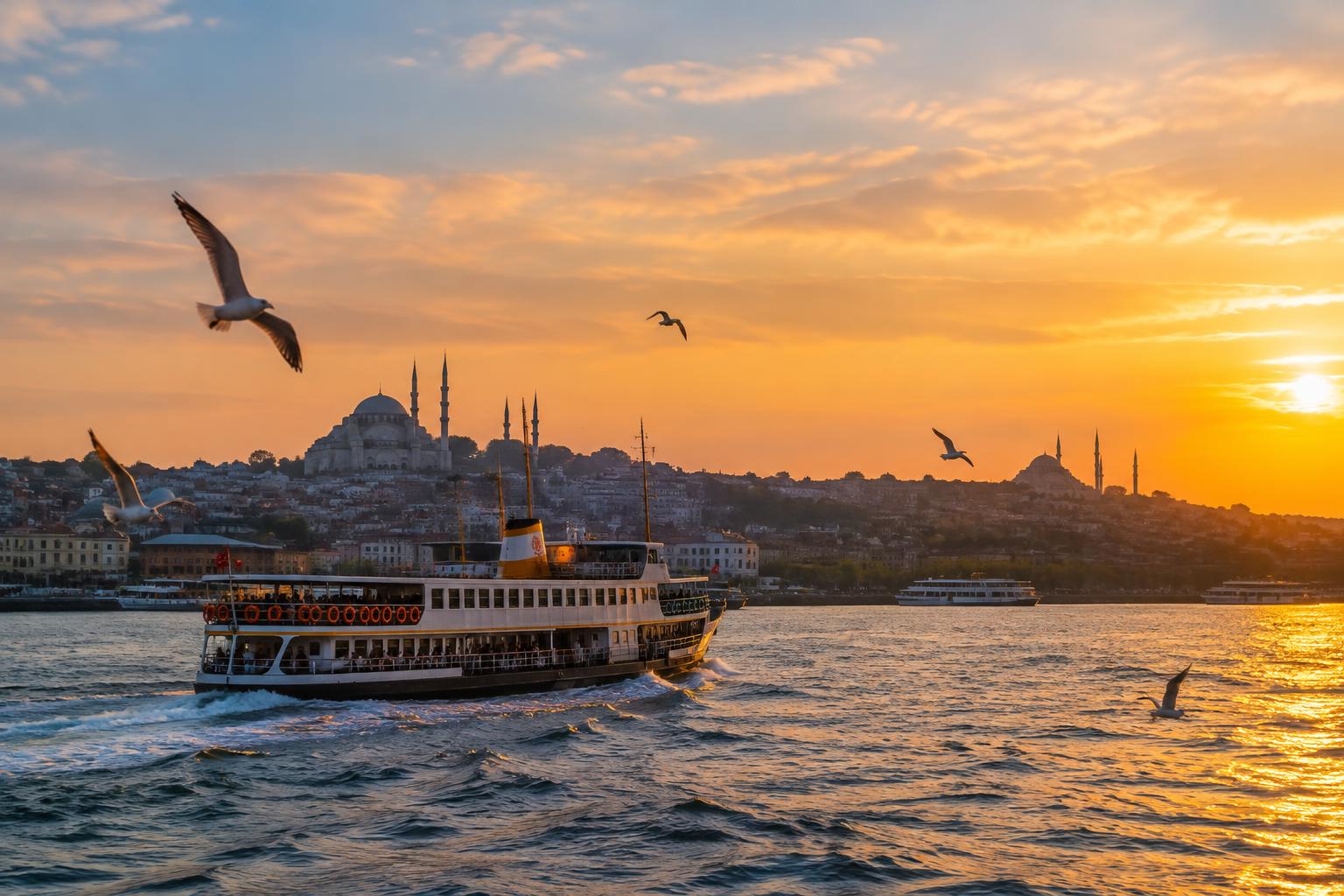
At a glance
- Ferries link the European and Asian sides across the Bosphorus and Golden Horn
- Istanbulkart works on ferries exactly as it does on metro, tram and bus
- Şehir Hatları runs the main public commuter lines; private operators run extras
- The Kadıköy–Eminönü and Üsküdar–Eminönü routes double as cheap sightseeing cruises
Istanbul is the rare major city where the most useful form of public transport is also one of the best things to do as a visitor. The Bosphorus strait physically separates the city’s European and Asian sides, and for most of Istanbul’s history crossing it meant taking a boat. Bridges and an undersea metro tunnel now exist, but the commuter ferry network, run principally by the municipal operator Şehir Hatları, remains faster than road traffic at peak times, considerably cheaper than a private tour boat, and arguably the single best vantage point on the city.
Who runs the ferries, and how they differ
Şehir Hatları (City Lines) is the public ferry operator, running scheduled commuter services between fixed terminals on both sides of the Bosphorus and up the Golden Horn. It operates under the umbrella of Istanbul’s municipal transport authority, İBB, and its boats accept Istanbulkart on the same basis as the metro and tram. Separately, private operators including Dentur Avrasya and Turyol run additional commuter and sightseeing routes, some of which also accept Istanbulkart and some of which sell their own tickets at the pier — it is worth checking signage at the terminal before queuing.
The core commuter routes
The busiest and most useful lines for a visitor run between Eminönü or Karaköy on the European side and Kadıköy or Üsküdar on the Asian side. These are genuine commuter routes, used daily by office workers, and they run frequently throughout the day rather than on a tourist timetable. A one-way crossing takes roughly 20 minutes and costs a fraction of an organised Bosphorus cruise, while covering much of the same water.
- Eminönü ↔ Kadıköy — one of the busiest commuter crossings, frequent departures
- Karaköy ↔ Üsküdar / Kadıköy — useful if staying near Galata or Karaköy
- Beşiktaş ↔ Üsküdar / Kadıköy — a shorter hop, handy from the Beşiktaş waterfront
- Üsküdar ↔ Eminönü — classic crossing with views of Topkapı Palace and the Golden Horn mouth
The Bosphorus tour line versus the commuter boats
Şehir Hatları also runs a dedicated, longer scenic service — often marketed as the Bosphorus tour (Boğaz Turu) — which sails further up the strait towards Anadolu Kavağı near the Black Sea, with a longer onboard stop and a higher ticket price than a standard commuter fare. This is a genuinely different product from the short commuter crossings: it takes roughly 1.5 to 2 hours each way depending on the stopping pattern, and is worth doing once for the full view of the waterfront palaces, fortresses and wooden yalı villas, but it is not the line to take if you simply need to cross for the afternoon.
Fares and Istanbulkart
Istanbulkart, the rechargeable card used across Istanbul’s metro, tram, bus and Metrobüs network, also covers Şehir Hatları ferries, with the same transfer discount applied if you board a ferry within the standard transfer window after using another form of transport. Cards are sold and topped up at machines near ferry terminals as well as metro stations, using cash or card. Tourists without an Istanbulkart can sometimes buy a token (jeton) at larger terminals, but this is now the exception rather than the norm and queues for jeton machines can be longer than simply buying a card on arrival.
Golden Horn ferries: a quieter alternative
Separate from the Bosphorus crossings, a Golden Horn ferry line runs along the inlet that separates the historic peninsula from Beyoğlu, stopping at Eyüp, Hasköy, Fener and Balat among others. This line is far less crowded than the main Bosphorus commuter routes and is a practical way to reach Eyüp Sultan Mosque, one of the holiest sites in Istanbul, and the colourful waterfront houses of Fener and Balat, without relying on buses through narrow hillside streets.
Timetables, disruption and weather
Şehir Hatları publishes timetables on its official site and through the İBB’s transport apps, and these are worth checking the same day rather than relying on a printed schedule, since services are reduced on public holidays and occasionally suspended in high winds or fog on the Bosphorus — a genuine consideration in winter months. Commuter crossings run from early morning into the evening, but frequency drops noticeably after the evening peak, so the last useful crossing for a same-day return should be checked rather than assumed.
Food, seagulls and onboard habits
Vendors selling simit (sesame-crusted bread rings) and tea are a fixture at ferry terminals and sometimes on board, and buying a glass of çay for the crossing is a genuinely local habit rather than a tourist affectation. Visitors are often tempted to feed gulls that follow the boats, a long-standing habit among commuters tossing simit over the rail; it is harmless and common, though should be done away from other passengers’ space on a crowded upper deck.
- Buy or top up an Istanbulkart at a terminal machine before queuing to board
- Distinguish the short commuter crossings from the longer scenic Bosphorus tour line
- Check same-day timetables, especially for the last return crossing
- Sit upside, outside, for the best views of the Bosphorus’s palaces and bridges
- Consider the quieter Golden Horn line for Eyüp, Fener and Balat
Accessibility and travelling with luggage
Şehir Hatları terminals generally have step-free access from the street to the pontoon, though the gangway gradient onto the boat itself can vary with the tide and the specific vessel, meaning wheelchair users and travellers with heavy luggage should allow a little extra time and ask terminal staff for assistance if needed. Large suitcases are permitted on commuter ferries without a surcharge, which makes the ferry a genuinely practical option for reaching accommodation on the Asian side directly from a hotel near Sultanahmet or Karaköy, rather than only a leisure trip.
Combining ferries with a one-day sightseeing plan
A popular and efficient day plan is to take an early commuter ferry from Eminönü to Kadıköy, explore the Tuesday or weekend markets and the Moda seafront on the Asian side through the morning, then return by ferry to Karaköy in the early afternoon in time to walk up into Galata and Beyoğlu before the evening. This uses the Bosphorus crossing twice in a single day without needing the longer scenic tour line, and costs little more than two standard Istanbulkart fares.
Seasonal timetable changes
Şehir Hatları typically runs a denser summer timetable from late spring through early autumn, adding extra departures on popular routes and sometimes additional stops on the Bosphorus tour line, then reverts to a reduced winter schedule once demand drops. Public holidays, including religious holidays whose dates shift year to year, also bring reduced or amended timetables across the network, so checking the specific date against the official timetable, rather than assuming a standard weekday schedule, avoids a wasted trip to the terminal, particularly in winter when fog and wind can also cause short-notice cancellations on exposed Bosphorus crossings.
Why the ferry beats the bridge for visitors
Road traffic across the Bosphorus Bridge and the Fatih Sultan Mehmet Bridge is often heavily congested at peak times, and the Marmaray undersea rail tunnel, while fast, offers no view at all. For a visitor without a fixed schedule, the ferry is usually the most time-efficient and consistently the most memorable way to make the crossing, turning a routine commute into one of the defining experiences of a visit to Istanbul.
Check before you go
Check Şehir Hatları’s official timetable for your specific route and date, since frequency drops on public holidays and services can be suspended in severe winter weather.
Sources and official information
- Şehir Hatları (Istanbul municipal ferries)
- Istanbul Metropolitan Municipality (İBB)
- Go Türkiye (Ministry of Culture and Tourism)
Prices and timetables are approximate and change often. Spotted an error? Tell us — corrections are noted under our editorial policy.
About the author
Marta OliveiraCity guides editor. Marta edits Caesar Plaza’s city guides, covering walking routes, public squares, neighbourhoods and public transport.
Related guides
City Guides
Using Public Transport in an Unfamiliar City Without the Stress
A practical guide to tickets, contactless payment and cards across London, Lisbon, Paris and Istanbul, for travellers new to each system.
By Marta Oliveira · 5 min read
City Guides
Walking a New City Safely: Practical Habits That Actually Work
Sensible, specific habits for walking unfamiliar cities confidently, with real examples from Lisbon, Paris, Marrakech and Istanbul.
By Marta Oliveira · 5 min read
City Guides
Navigating the Marrakech Medina Without a Guide
Practical orientation strategies for exploring Marrakech’s medina independently, using landmarks, named gates and Jemaa el-Fnaa as an anchor.
By Marta Oliveira · 5 min read